



South Africa generated roughly $550 million (R10.1 billion) in defence exports in 2025, with weapons, ammunition and military equipment sold to buyers including France, Turkey, Kenya and the United Arab Emirates, highlighting the country’s growing role as one of Africa’s key arms suppliers amid rising global demand.
South Africa records over $550 million in arms sales to France, Turkey, Kenya, UAE and 38 othersSouth Africa records over $550 million in arms sales to France, Turkey, Kenya, UAE and 38 othersSouth Africa generated $550 million from defence exports in 2025, selling weapons, ammunition, and military equipment to 42 countries, including France, Turkey, and the UAE.The largest export share went to Europe, with munitions making up the bulk of the transactions—Germany was the top buyer, ordering around $180 million worth of shells.Armoured vehicles and aircraft were exported widely within Africa, with Kenya, Ghana, and Malawi among the major vehicle buyers, while aircraft were sold to Iraq, DRC, Mozambique, and the UAE.South Africa is nearly unique in Africa as a significant arms exporter, while most other African countries remain major importers of weaponry, mainly from Europe, China, Russia, and the United States.Recommended articlesWorld’s largest ride-hailing company pledges over $300 million investment in Africa’s largest economymarkets World’s largest ride-hailing company pledges over $300 million investment in Africa’s largest econom
National Conventional Arms Control Committee (NCACC) show that 582 export permits to 42 countries were approved last year, covering ammunition, armoured vehicles, aircraft and electronic warfare systems, amounting to about $550 million (R10.1 billion).The total nearly triples the $190 million (R3.6 billion) recorded in 2024, reflecting a sharp increase in international demand for South African-made military equipment and munitions.Europe accounted for the largest share of exports, followed by the Middle East, Africa and Asia-Pacific markets.Munitions lead export surgeMunitions accounted for the largest portion of exports, with Germany emerging as the biggest buyer after ordering 73,586 shells worth about $180 million.Turkey also purchased 35,000 shells valued at roughly $37 million, while Estonia acquired 18,540 rounds worth around $11 million and Australia bought 10,272 rounds valued at approximately $15 million.South Africa also exported measuring and communications equipment, with India securing the largest contract (219 items), followed by France (17 items), Bangladesh (377 items) and Brazil (10 items).Dual-use exports included information security systems supplied to seven countries, two lasers delivered to the Netherlands, and a single unmanned aerial vehicle exported to Colombia.
Although South Africa also imports limited defence equipment from foreign suppliers, these purchases remain relatively small.Recent acquisitions included unspecified weapons from the United Kingdom, Slovakia and the United States, bombs from Serbia and Belgium, and ammunition from several countries including China.The country also sourced alert systems from India and communications and navigation equipment from European suppliers, reflecting a focus on specialised components rather than major weapons platforms
While some African nations maintain defence industries with limited transparency, most across the continent remain net importers of arms, relying on suppliers from Europe, the United States, China and Russia.Countries including Ethiopia, Egypt and Algeria have sourced significant military equipment from Chinese and Russian manufacturers in recent years, while Nigeria has procured systems from a mix of suppliers including China, Italy, the United States and Turkey.According to the SIPRI report 2026, Morocco and Algeria, two North African military powers, primarily feature as major importers rather than exporters.Morocco ranked 28th globally among arms importers, recording a 12% increase, while Algeria ranked 33rd despite a 78% decline.The contrast highlights South Africa’s relatively rare position as a continental supplier, exporting locally produced ammunition, vehicles, aircraft and electronic systems to markets across Africa, Europe and the Middle East.
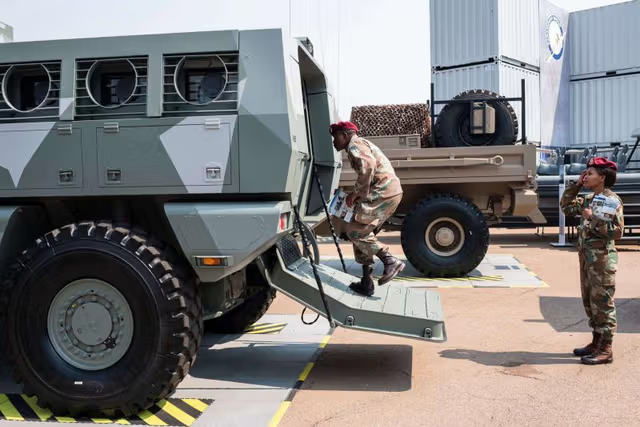
According to the report, more than 130 South African-made vehicles were exported, with the largest orders coming from Kenya (34 vehicles), Ghana (30 vehicles), Malawi (15 vehicles), Cameroon (11 vehicles) and the United Arab Emirates (10 vehicles).Unspecified aircraft were sold to Iraq (six units), the Democratic Republic of Congo (four), Mozambique (two) and the United Arab Emirates (one).The NCACC also reported that two naval vessels were sold to Tanzania during the year.More than 10,000 light weapons were also exported to multiple countries, with Zimbabwe accounting for the largest single order.South Africa stands out in import-dependent continent
African buyers and vehicle exportsArmoured vehicles formed another portion of exports, with African buyers among key customers
Notably, South Africa’s defence exports are driven by established manufacturers including Denel, Rheinmetall Denel Munition, Paramount Group and Milkor.These companies produce artillery ammunition, armoured vehicles, aircraft, drones and naval systems for both the South African National Defence Force (SANDF) and export markets across Africa, Europe and the Middle East
