







Africa’s largest trade finance institution, Afreximbank, has announced an initial $8 billion financing package for its newest member, South Africa, supporting projects across mining, automotive manufacturing, and industrial development.Afreximbank has announced an $8 billion financing package to support South Africa’s economy.South Africa has now attained ‘Class A’ shareholder status in Afreximbank.This membership coincides with growing trade tensions with the United States, as recent tariffs have significantly impacted South African exports.The initiative reflects South Africa’s dedication to promoting regional industrialisation and strengthening trade ties within Africa.
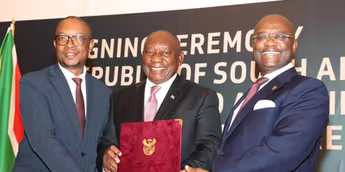
The announcement was made on Wednesday during a ceremony in Johannesburg by Afreximbank President George Elombi.South Africa was unable to join Afreximbank fully when the bank was established in 1993 due to the country’s apartheid-era status. Last year, however, the South African cabinet approved a plan to upgrade the country to a “Class A” shareholder, enabling full participation.Elombi said the $8 billion package would prioritise mineral processing, the expansion of automotive manufacturing, and the development of industrial parks and specialised economic zones.
The timing of South Africa’s membership aligns with its growing need for alternative export markets amid rising trade tensions with the United States. In August, U.S. President Donald Trump imposed a 30% tariff on South African exports—the highest in Sub-Saharan Africa.President Cyril Ramaphosa said joining Afreximbank reflects South Africa’s commitment to African industrialisation and deepening trade and investment ties across the continent.Ratings scrutiny and calls for African alternativesAfreximbank has recently come under scrutiny after Fitch downgraded the bank to “junk” status last month and removed its outlook for future ratings.
Responding to the downgrade, President George Elombi highlighted the bank’s financial strength, noting that its treasury functions remain solid and that its continued alignment with member-state policies ensures sustained investment opportunities.While credit ratings are a key tool for investors in allocating capital, Africa’s financial markets remain heavily influenced by the “big three” global rating agencies—Moody’s, S&P, and Fitch—which together control roughly 95% of the ratings industry.African leaders and the African Union have long criticised this dominance, arguing that global ratings often misrepresent the true risk of lending to African countries and are now planning to develop a home-grown alternative.Critics say the major agencies are quick to downgrade African nations but slow to recognise improvements, reinforcing negative perceptions and driving up borrowing costs


