







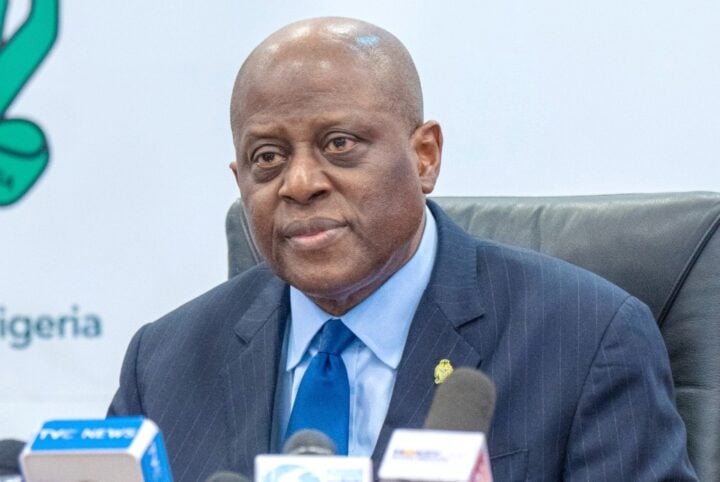
The Governor of the Central Bank of Nigeria (CBN), Mr. Olayemi Cardoso, has disclosed that Nigeria’s external reserves have risen to about $49 billion as of February 5, 2026, describing the development as a clear sign of improving confidence in the country’s economy.Cardoso spoke on Monday in Abuja at the second edition of the National Economic Council (NEC) Conference, where he explained that the growth in reserves represents a 4.93 per cent increase from the last figure of $46.7 billion which marks a major turnaround from what the country faced when the current CBN leadership took over.“This is obviously a very important statistic,” Cardoso said. “When we took over, the net reserve figure was about $3 billion. As at the end of last year, the net reserve figure had gone up strongly into the 30s. And as I said, as of February 5, 2026, it is $49 billion. We are now net buyers.”
He explained that the CBN now allows the foreign exchange market to largely determine prices, while the Bank steps in to buy foreign exchange when necessary. According to him, this approach has helped to close the gap between the official and parallel market exchange rates. “The premium between the official and parallel market rates has collapsed to under two per cent,” he said.Cardoso said remittances from Nigerians living abroad have played a major role in boosting the country’s foreign reserves. He noted that Nigerians in the diaspora come from all parts of the country and are keen to support the economy by sending money home.
Remittances have made a big difference to how we have grown our reserves,” he said. “The diaspora come from every single state represented here. We have engaged with them and made it easier for them to remit money back to Nigeria
He added that the cooperation of state governors and otheCardoso recalled that in the past, the naira was widely rejected in parts of the West African sub-region, but said that situation has changed. “In those days, if you went around West Africa and gave them naira, nobody wanted to touch it,” he said. “That has all gone now. There is predictability and you can plan.”He warned Nigerians who are holding foreign currency without real need that such actions could lead to losses. “Those holding unnecessary foreign exchange reserves are losing money every day,” he said.On the banking sector, Cardoso said ongoing recapitalisation efforts are strengthening banks and positioning them to support Nigeria’s long-term economic goals, including the ambition to build a $1 trillion economy.
We all know how important the banking system is,” he said. “Banks are recapitalising, investors are earning positive real returns, and equity markets are recovering due to improved earnings and stability.”He said the CBN is also working on clear succession rules to ensure smoother leadership transitions in banks and greater resilience during periods of uncertainty.Cardoso said recent economic data shows signs of stability, pointing to GDP growth of 3.98 per cent, a strong current account position, and a $3.42 billion surplus recorded in the third quarter of 2025. “We haven’t had this kind of current account strength in a very long time,” he said.
He also noted that inflation has moderated to about 15.15 per cent, adding that the figures show that recent reforms are producing results
According to him, the CBN has developed a roadmap for the period from 2026 to 2030, aimed at using macroeconomic stability to drive productivity and growth. “Without stability, there will be no growth,” Cardoso said. “If there is something positive that has come out of this, it is the fact that we now have stability.”He explained that the roadmap focuses on reducing inflation, normalising the foreign exchange market, and strengthening the financial system. In simple terms, he said, the CBN plans to stay on course with current policies. “We will continue doing the things we have done,” he said.
Cardoso said key priorities include price stability through a gradual move towards inflation targeting, strengthening external reserves, and protecting the value of the naira. “We will do whatever it takes to safeguard the value of the naira,” he said.He, however, warned that there are still risks that must be carefully managed. One of them, he said, is excess liquidity in the system. “There is still a lot of liquidity in the system and we must manage it very carefully,” he said. “We are not out of the woods yet.”He also pointed to the election cycle as a possible risk, noting that large spending during election periods could threaten economic stability if not properly managed.
Cardoso stressed that monetary policy alone cannot solve all economic problems. “Monetary policy is necessary, but it is not enough on its own,” he said. “No central bank can sustainably deliver low inflation where issues like food supply shocks, high energy costs, and poor infrastructure continue to push prices up.”He said lasting stability requires fiscal discipline, supply-side reforms, and strong cooperation among government institutions. “Monetary stability requires fiscal discipline and credibility,” he said. “Policy coherence is a strong anchor for stability.”Cardoso said the CBN will continue to maintain a disciplined interest rate path, while fiscal authorities are expected to support policies that improve revenue, manage debt responsibly, and modernise public financial management.
He also stressed the importance of state governments, saying subnational governments control a large share of public revenue and can strongly influence inflation, growth, and overall economic stability. “Subnational governance can significantly affect macroeconomic outcomes,” he said.The CBN governor urged state governments to align with national stability goals by investing in infrastructure, managing debt responsibly, and working with the financial system to expand access to credit and promote financial inclusion.Looking ahead to 2030, Cardoso said success would mean single-digit inflation, growing foreign exchange reserves supported by non-oil exports, foreign investment, and remittances, as well as a strong and inclusive financial system. “Our view is that the future is looking bright,” he said.
In his welcome address, the Minister of Budget and Economic Planning, Senator Abubakar Atiku Bagudu, praised President Bola Ahmed Tinubu for the reforms carried out so far, saying they have improved the financial position of states and local governments.“Today, a more united federation is gathered here because of the choices you made,” Bagudu said. “Your reforms have improved the fiscal condition of states and local governments, while much of the burden is borne by the Federal Government.”He said the President’s focus on grassroots development reflects true federalism and has encouraged states to support national reforms.
Bagudu said members of the National Economic Council, representing the 36 states and the Federal Capital Territory, have actively participated in shaping reform measures and largely support the direction of the government. “Most of them, regardless of party, believe you are pursuing what the country needs,” he said.He added that governors have been working closely with the Federal Government on key national issues, including security, infrastructure, fiscal and monetary coordination, and efforts to boost domestic production and curb oil theft.


